Showing posts with label Books. Show all posts

11.06.2012

Laugh out loud


I'm taking suggestions, dear readers. I know that most blogs give out recommendations, but I'm reverse blogging and here to collect your wisdom.

Here's the deal: with adrenal burnout I can only watch, listen to or read funny things. Seriously!


Anything with suspense, sadness, violence, etc... shoots up my cortisol levels and my adrenals can't handle it. Intense dreams, insomnia, heart palpitations--I'm a basket case*. Ridiculous, I know, but it is what it is.

As long as I can remember I've been a sensitive type (with a special talent for turning red or crying in the most inopportune situations). Regardless, I've always loved dramas, painfully real (or fatastically unreal) films, even some violence (of the Kill Bill type), action,  you name it, if it is written well, I probably loved it.

But now is the time in my life for comedy.

Here are some parameters for your suggestion: I only have a computer-- no TV-- but I can watch shows on hulu or netflix (or rent dvds). I already watch a few shows such as The Office, New Girl, Parks & Recreation, The Daily Show and Colbert Report... SNL clips, Louis CK. I'll also listen to podcasts.

I need more! especially books-- the books don't have to be pure comedy (although I love David Sedaris). I did mostly ok with the Ya Ya Sisterhood recently (but had to put it down for a while when it got intense and had nightmares all night--crazy).

I'm a voracious reader,  so load me up, please!

*my mom's phrase-- often used to describe me as a child-- what does that even mean?

4.02.2012

Run Free! A tribute to Caballo Blanco Part 1

Caballo Blanco & Odin taking a quick break on Day 3.
Micah True, also known as Caballo Blanco, died at age 58 last week while out for a run in the Gila Wilderness of New Mexico. He was recently made somewhat famous by Christopher McDougall's book Born To Run.*

Blessed with some serious good luck, I  experienced the most incredible hike of my life in la Barranca del Cobre (Copper Canyon) in Mexico with this amazing man.

El Paraiso del Oso
It was back in the year 2000 and I was living at a remote lodge--El Paraiso del Oso in Cerocahui, Chihuahua, Mexico. By remote I mean that to get there you take a 6 hour train ride from Los Mochis (in the south) or Chihuauhua in the north, get off in Bahuichivo, then hitch-hike down a dirt road or meet the hotel van for ride to Cerocahui.** At the time, Cerocahui was  completely "off the grid". The town had a generator that ran for some hours each evening-- but that's it. Being a a mile or so out of town, El Paraiso was even off of the Cerocahui grid. There were solar panels for the refrigerators and there was also a generator that ran once in a while.

The owner, Doug, paid me a stipend to be a resident English speaker during the summer off-season when he was away from the lodge.  I assisted as a  guide on horse-packing and backpacking trips with mainly European tourists into the Urique Canyon. (Bonus: I also learned Mexican-mountain-style Spanish and got to hike with my dog, Odin, every day in the wilderness basically following butterflies and bouldering. One time I even found the coolest natural rock water slide tucked in between the madrones and pines that was about 100 feet long..

but I digress....
One August night, Caballo Blanco and his friend, Jay showed up at El Paraiso. Caballo lived in the Copper Canyon every winter and ran hundreds of miles through the mountains (which is how he got the name Caballo Blanco).  The native Tarahumara also run hundreds of miles through these mountains. That's just what they do. To subsist, Caballo guided tourists through the canyons--but not just any tourists, he told me. No whiners.

Caballo and his friend were embarking on a 3 day, 50 mile hike into the Urique Canyon, back up the other side and then down into Batopilas canyon. Caballo suggested that I join them, and Doug (who knew him) said to go for it, so I did. The next morning, I headed out with  a couple of peanut butter sandwiches, a water bottle, my Teva sandals, a back-up crappy pair of low-hikers and socks, a Ridge Rest foam pad and an old flat sheet for sleeping, a sun hat and some sort of camera. Maybe I had an extra shirt and pair of long pants?  No joke, that's all.  That's just how I roll. (Ahem....or used to....before kids. Oh, how I miss feeling that free...)

The first day we hiked 23+ miles into the Urique canyon, first climbing 1600 feet in elevation and then descending 6000 feet through pine forest and down into lush subtropical land with macaws and mango trees. My Teva straps blew out in the mud on the way down, so I switched to the really old, cheap hiking shoes. We cooled off in swimming holes and Caballo  taught me how to run efficiently down hill through the trails.

About seven hours later we were in the town of Urique and found a  room to share at the Hotel Canon Urique followed by dinner and Tecate at Mama Tita's. We sat in the picturesque courtyard of Tita's home and restaurant while she whipped up fresh salsa, frijoles and other deliciousness. That night, I lay in bed with my legs up the wall-- my feet swollen and throbbing.

To be continued....
Next up: We head out for an easy, 8 mile day--although straight up. ...and then Odin takes out a baby goat.

* Born to Run is such a good book, by the way. I don't think you have to love running to like it. In fact, Jason despised running until he read the book.
**When I moved there, I actually drove in from the north-- but I wouldn't advise it (think flash floods, winding, dirt mountain roads and drug cartels)! That's a story for another time.
2.04.2012

What you practice is what you have. (a declaration of liberation)

 I finally decided that enough was enough. I will not postpone happiness until life is less stressful.  Anxiety will no longer  trump my peace card.

I am finished focusing on 'self improvement' and giving power to the critical voices in my head. Trying to be 'better' at EVERYTHING is exhausting. It doesn't work. It's not like I'll reach a certain point and finally satisfy the voice that tells me "You can do BETTER!" Because there is always somewhere to go.

Instead, I will practice feeling like I have already arrived at 'Better'. Instead of practicing being self-critical and overwhelmed, I will practice letting those thoughts pass by and directing my attention to my body, to what is happening in the moment.

These trees remind me to stop.
I picked up another book of Cheri Huber's: What You Practice is What You Have, in the same week as Desi directed me to Danielle LaPorte's website: White Hot Truth. The similarities between the messages of these two teachers (one a Zen monk and the other an inspiring entrepreneurial coach) was synchronistic for me.

They are saying the same thing:

"Self improvement infers there’s something wrong with you, so you’re already starting off with a disadvantage.
Of course there’s something to improve — always will be, life is an evolutionary equation. But liberation is about consciously choosing your perspectives, moment to moment, so let’s choose viewpoints that are advantageous and give us warm fuzzy, encouraging feelings."
--Danielle LaPorte, "Why Self Improvement Makes You Neurotic", White Hot Truth

I am all for liberation. In fact, I am practicing liberation right now.

What are you practicing?

1.10.2012

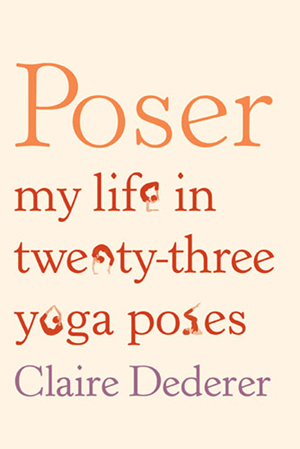
Book Notes: *Poser, my life in twenty-three yoga poses* by Claire Dederer

This is not a yoga book. It's not a book that preaches about being present or 'just breathing'.  It is a memoir that made me laugh out loud and also made me seriously reflect on some of my own crap. Claire is a new mom in her 30s who starts to do yoga. She is plagued by her own perfectionism and this is the story of how she begins to let it go.

She is irreverent to the whole yoga thing (which I love).  In one scene, Claire has just walked into her second yoga class (she is skeptical). Enter: the teacher:
"I am Atosa," she said. Like hell you are, sister.

Descriptions of the over-educated mom trying to make all of the right choices really hit home with me. Breastfeeding, making her own baby food (organic, of course), choosing the 'right' preschool. These things were the 'rules' of Claire's liberal neighborhood in Seattle.
Our goodness was driven by an underlying terror: What if we stopped?....There was trouble lurking at the edge of my effort; all I could do was everything, and do it right.

  This made me ask myself, "What would happen if I stopped being 'good'?" Hmmmm. Am I putting too much pressure on myself? Let me rephrase that. I mean, I know that I'm putting too much pressure on myself... to parent correctly, 'wife' correctly, create correctly, career correctly....but is it because of fear? It sounds almost ridiculous. OF COURSE it's because of fear, right? What else could it be?

It reminded me of what a well-intentioned therapist, Steve, once said to me when I was talking about the pressures I was putting on myself at work (teaching at a charter school): What would happen if you were just 'good enough'? 

I realized that 'good enough' made me uncomfortable. How could I do that? I must do the absolute best job that I can at all times or..... or what? I couldn't even fathom it. I couldn't imagine not putting in my best effort at work. It was black or white for me. Either I would be doing the best job or I would be a crappy teacher. There was no in between. No balance. Insanity. I never thought I was a perfectionist because I don't care too much about getting all the lines straight or the 'i's dotted. I am more free-form. I'm big picture, not details. I didn't realize that there are many ways to be a perfectionist.

But enough about me and my analysis paralysis.

Back to the book. I loved it. When I finish up the biography of Steve Jobs (a much more intense perfectionist) I might just have to read it again.


10.05.2011

Book Notes: Recommended.

Now that I'm not teaching full time I get to read novels again! It's a complete escape for me. I'm highly picky so I have to find books that are well-written and not too depressing (the second part has just become true over the past 5 years--same with films.)

Here are some books that I've loved lately.
(note: I've linked to Amazon, but if you have a local bookseller, please consider supporting her instead of ordering online. I know it's tough with cost--I usually go for the library, myself--but people like my friend--the owner of Sustenance Books in Murphys, CA--will appreciate it.)

1. Peace like a River, by Leif Enger. My friend (the bookstore owner) loaned this to me and at first I wasn't sure that I'd be thrilled with it. But after the first chapter or so I was in love. It's one of those books that I didn't want to end. It reminded me of all the books I read as a kid-- the ones that really took me out of my reality and gave me a warm, cozy feeling. It's about a family with a single dad in the northern midwest. The older brother becomes an outlaw and the rest of the family goes on a quest to find him. It is told from the younger brother's perspective. Did I say that I love this book?


2. Song of Solomon, by Toni Morrison. She is such a beautiful story teller.  I like to read her words again and again just to hear the sound of them. The story of Macon Dead III (nicknamed Milkman)  is well crafted and mythic just like her other novels.

3. Half-Broke Horses, by Jeannette Walls.  Have you read Jeannette's first book, The Glass Castle? If not, read that first--it was one of my favorites. While The Glass Castle was about the author's childhood--a memoir of growing up in an unbelievably dysfunctional family, Half-Broke Horses is about her magnificently strong grandmother. It's a fun read--especially if you've read the first book.

4. Love in the Time of Cholera, by Gabriel Garcia Marquez. Loved it. He's a Nobel Laureate for a reason. It's about love in its many forms, but it's not at all a 'romance'. Like Toni Morrison, Marquez develops dynamic characters that you know so well by the end of the novel.


That's all for now. Another post later for non-fiction--I'm talkin': Outliers,  by Malcolm Gladwell, Playful Parenting, by Lawrence Cohenand Simplicity Parenting, by Payne & Ross.

Damn. It's been a hell day for me and the babies and one of them is awake! I haven't even emptied the dishwasher, never mind tried to close my eyes.... We're heading to the garage so as not to wake up the other.


4.24.2011

Book Notes~ *NurtureShock: New Thinking about Children*

I've had the lone copy of this book checked out of the Murphys library for 6 weeks, but this is one I'd like to own.  It is such a good read-- well researched and fascinating (if you're into learning about new research, parenting, education or psychology). It's 4 days overdue now, so I figured that I better jot down some notes on my favorite parts. (wish I had done this as I was reading-I'll have to read it again!):
  • The Inverse Power of Praise: Stop saying "Good Job!" or "Good helping!" etc.... I had already read about the work by Dweck, but this had more detailed information. Praise actually lowers self esteem (in children--not adults)--which is probably the opposite of the intended effect. Also, kids who were told "you must have worked hard" rather than "you must be smart" consistently chose to challenge themselves and take on tougher work. The kids who were told they were smart were too afraid to fail and chose the easy way. They also cheat more.  
  • The lost hour: Adolescents are much harder hit by sleep deprivation than adults. Teenagers who were given just one more hour of sleep (later start for school) had significantly lower rates of depression and other psychological issues, and they performed better academically. They're hard-wired to stay up late and sleep in. Duh. Why don't schools start later?
  • Why white parents don't talk about race: because they think that not talking about it will make their children 'color blind'. Not the case. Kids notice differences and tend to make the assumption that people who look like them also have "good" qualities like them--and those that don't aren't so nice. Solution? Openly talk to kids about race beginning at age 3. By high school--or even late elementary school they have already segregated themselves and formed prejudices that are harder to break.
  • Why kids lie (elementary school): --to avoid punishment, and later to get attention, spare feelings or manipulate social situations. Most parents think their kids don't lie. Not the case--in some studies 96% of kids lie...and they don't grow out of it, they get better at it. Solution? Not punishment (doesn't work for anything except in the short term)--but helping them to develop understanding of how their lies affect other people.
  • The Search for Intelligent Life in Kindergarten: This chapter reveals research that refutes the practice of early IQ tests used to place students in gifted programs for the next 12 years. Insane! Who would do that? Most of the country. Even if IQ is more stable at 3rd grade than in kindergarten I don't think there should be better programs for the 'gifted'. How unfair! How ridiculous! Everyone should get the 'good' stuff.
  • The Sibling Effect:  Siblings aren't fighting about parental affection--they're most often fighting about sharing physical possessions. Having a sibling doesn't necessarily influence one's social skills for the better--it could make them worse. How to help siblings to get along? --teach them to be friends-- how to choose activities they can do together, how to invite each other to play or recognize when someone wants to be alone. 
  • The Science of Teen Rebellion: All teenagers lie-- some more than others. Why? Usually to avoid disappointing their parents. How to minimize lying?--consistently enforce rules, respect a teen's need for autonomy, be warm, loving and talk to your kids. And....it's a good sign if teens are arguing with their parents--it's a sign of respect. Arguing=honesty. Kids that argued more lied less. This was my favorite chapter--lots of good stuff.
  • Can Self-Control be Taught? : Tools of the Mind is a preschool and kindergarten program that is hugely successful--in fact it is the most successful education program out there. Most programs don't (with statistical significance) reach goals with all students because human behavior is too hard to change. Tools of the Mind sounds incredible! All schools should use it. It teaches through play and builds a culture of meta-cognition and critique in 3-5 year olds! wow.
  •  Plays well with others: Educational television increases relational aggression in young children. Preschoolers can't pull lessons out of a 30 minute show. Instead, they see relationally aggressive behavior modeled on a show like Spongebob and they copy that behavior in real life...even if the final lesson in the show was that the behavior is wrong. Also-- it's okay to argue in front of your kids as long as they see you resolve it. 
and finally----
  • Why Hannah talks and Alyssa doesn't: This chapter talked all about research on the development of language. It was super interesting but I'm running out of free-time here. Bodhi needs some attention! Basically....talk to infants like you're carrying on a conversation (let them respond). Name everything for them at the right time (when they're looking at an object). More than one person naming it helps more. Move the object as you name it if they're under 15 months. 
I love learning about how the brain works.


Related Posts Plugin for WordPress, Blogger...